No, forward deployed engineers (FDE) aren't being sent into battle. Although, depending on the customer's legacy systems, you might hear an argument for that.
Here's what the role involves, why companies like AI start-ups are hiring for these roles, and what it takes to become an FDE.
What is a forward deployed engineer?
A forward deployed engineer is a software engineer who ships code inside a customer's environment, integrating a product with their systems, data and infrastructure. Where most engineers work on the core product, an FDE owns a customer's deployment end to end. They:
- scope the problem with the customer's engineers and domain experts, turning vague requirements into something buildable;
- write production code in short cycles against customer deadlines: API integrations, data pipelines, internal tools and agent workflows that connect the product to the customer's stack;
- harden it for production, from auth and permissions to legacy systems, inconsistent data, latency and edge cases;
- push what they learn upstream as feature requests, bug reports and reusable components, so the next deployment needs less custom work
Palantir was one of the first to use this model, sending engineers into defence agencies, banks and large enterprises to get its platform working. Now, AI companies like OpenAI and Anthropic are doing the same to get their tools working inside customer businesses.
What does a forward deployed engineer do day to day?
An FDE's day is split between the customer and the code. A typical week mixes:
- Customer sessions. Calls and workshops to clarify requirements, show progress and get decisions made.
- Writing code. Mostly integrations, pipelines and workflows inside the customer's environment.
- Problem-solving in the customer's stack. Getting to grips with new systems and data quickly, and finding the best way to make the product fit.
- Syncing with the product team. Flagging bugs, pushing feature requests and finding out what's coming that could help.
- Travel. For workshops, launches and on-site work when the customer needs it.
What does a forward deployed engineer do on a typical project?
Every customer is different, but let's use a 12-week engagement as a baseline.
AI coding tools have sped up much of the build work, so many FDE teams aim to get their first use case in front of users within six weeks, then double down on robustness and expand from there.
Here's what that might look like in practice:
Weeks 1-2: Discovery.
Agree on the first use case, map the systems and data involved, and get access approved. Start security approvals on day one. They can take weeks, and you don't want them holding up the build.
Weeks 3-4: Prototype.
Build a working version using the customer's own data. This is where you prove the use case and find the tricky bits before going further.
Weeks 5-6: First release.
Get one focused use case into production with a small group of users. AI coding tools help speed up integrations, tests and boilerplate, leaving the FDE more time to focus on the logic specific to that customer.
Weeks 7-9: Harden.
Get security sign-off, add monitoring, and, for AI products, set up evaluations to ensure outputs are reliable.
Weeks 10-11: Roll out.
Bring more users on board and start adding the next use cases on top of what's already live.
Week 12: Handover and feedback.
Give the customer's team the documentation and runbooks they need to take ownership, and feed reusable patterns back to the product team.
On larger accounts, the work rarely stops at the first deployment. Once one use case is up and running, FDEs move on to the next, gradually expanding the product's role across the customer's business.
FDE vs solutions engineer, software engineer, and contractor
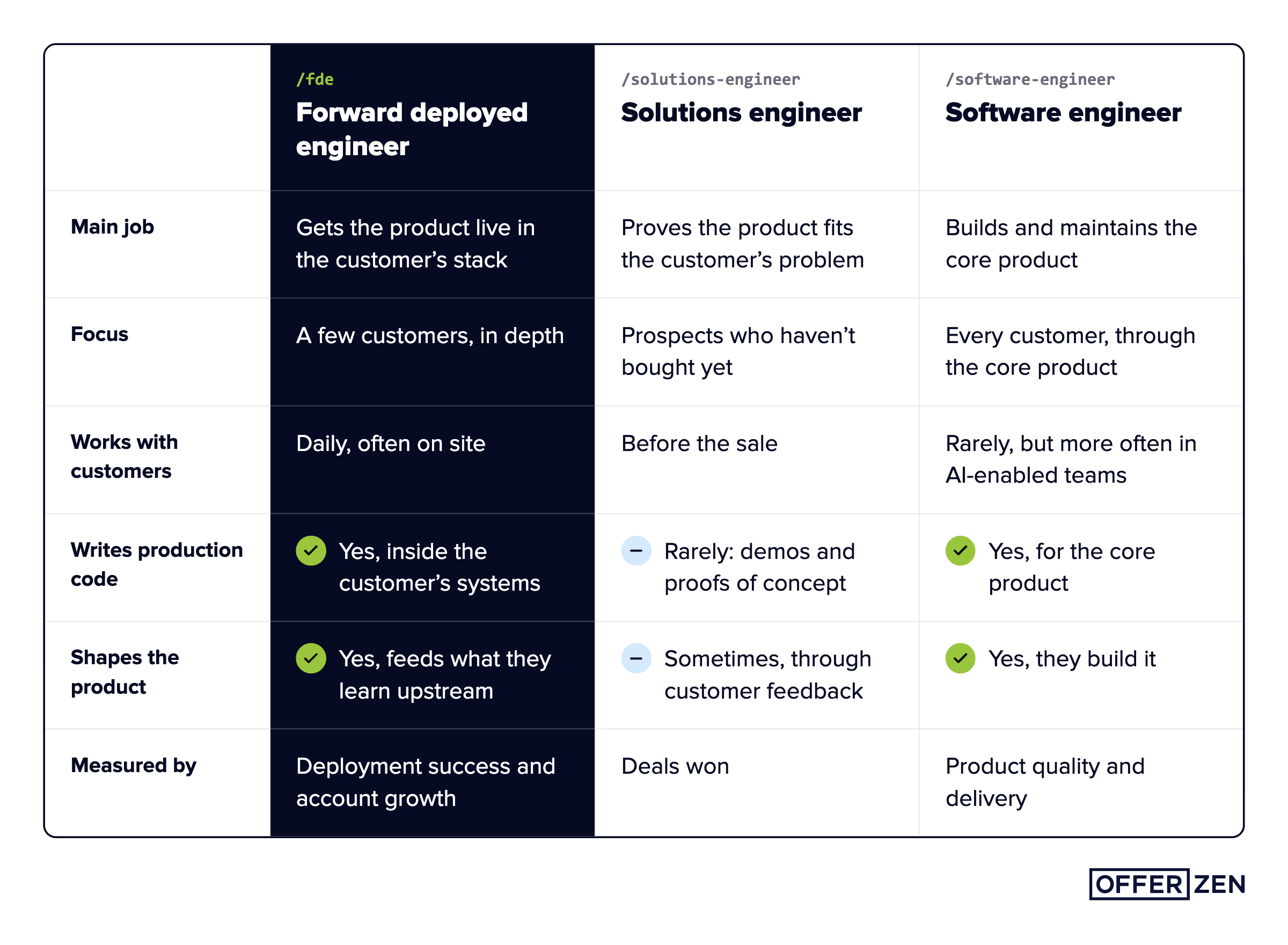
FDEs draw on skills from all three roles. The difference? They write production code inside a customer's business, representing the product company.
FDE vs. solutions engineer
- Solutions engineers help close the deal, using demos and proofs of concept to show what a product can do.
- FDEs come in after the deal is signed, writing and shipping production code to make the product work inside the customer's business.
FDE vs. software engineer
- Software engineers build the core product customers use, usually with little direct customer contact.
- FDEs work closely with individual customers, building the code and integrations needed to make that product work in their specific environment.
FDE vs. contractor
- Contractors are hired by a client to deliver a specific brief, then move on to the next project.
- FDEs work for the product company, not the client. What they learn from each deployment feeds back into the product, making it better for everyone.
What is the average salary for a forward deployed engineer in South Africa
FDE is still a new role in South Africa, so there's no established salary benchmark yet. But early OfferZen marketplace data gives us a useful starting point. A small group of FDE candidates on OfferZen with 2-6 years' experience expect around R100,000 a month.
That's about £4,500 per month and £54,000 a year for UK companies hiring in South Africa. For comparison, FDEs in the UK earn a median total compensation of around £146,000 a year, including bonuses and equity, according to Levels.fyi.
Job ads point to strong local demand too. One AI company hiring an FDE in Johannesburg through OfferZen in September 2026 advertised pay at the 95th-99th percentile of local market rates.
Hiring for a specific role? Use the OfferZen salary calculator to see what the market is paying.
What kind of companies hire forward deployed engineers?
FDEs tend to work for companies whose products are powerful but not particularly easy to plug in and use. If a customer can sign up and get value straight away, there's probably no need for an FDE.
But if getting value means connecting the product to messy internal systems, sensitive data and complicated workflows, that's where an FDE comes in.
These companies tend to have a few things in common:
- They sell to large organisations: Think banks, insurers, retailers, healthcare providers and government.
- Their contracts justify the investment: There's enough revenue on the table to support several engineers working with a customer for months.
- Their product needs tailoring to each customer: Its value often comes down to how well it connects to the customer's data, systems and workflows.
Do forward deployed engineers work on site?
It depends on the company and the type of customer they're working with. Some companies offer fully remote FDE roles, while others expect engineers to spend a few days a week at customer offices.
Remote, the global HR platform, advertised a remote FDE role in 2026 with around 10% travel for customer engagements. Lenovo also advertised a remote FDE role with up to 25% travel. Others are much more office-based, with one role on OfferZen requiring four days a week at a client's office.
On-site work is particularly important when:
- The customer runs secure or classified systems. These often can't be accessed remotely, which is common in government and defence.
- Data is tightly regulated. Think banks, insurers and healthcare providers, where access comes with extra restrictions.
- You need to see how work actually happens. Sitting with a claims team or call centre can reveal problems and workarounds that no requirements document will capture.
What makes a strong forward deployed engineer?
Strong FDEs combine broad engineering skills with the ability to work through business problems alongside non-technical people. They start by understanding the problem the customer is trying to solve, then work out how to build a solution. Many of these skills overlap with the software engineering skills tech leaders are hiring for.
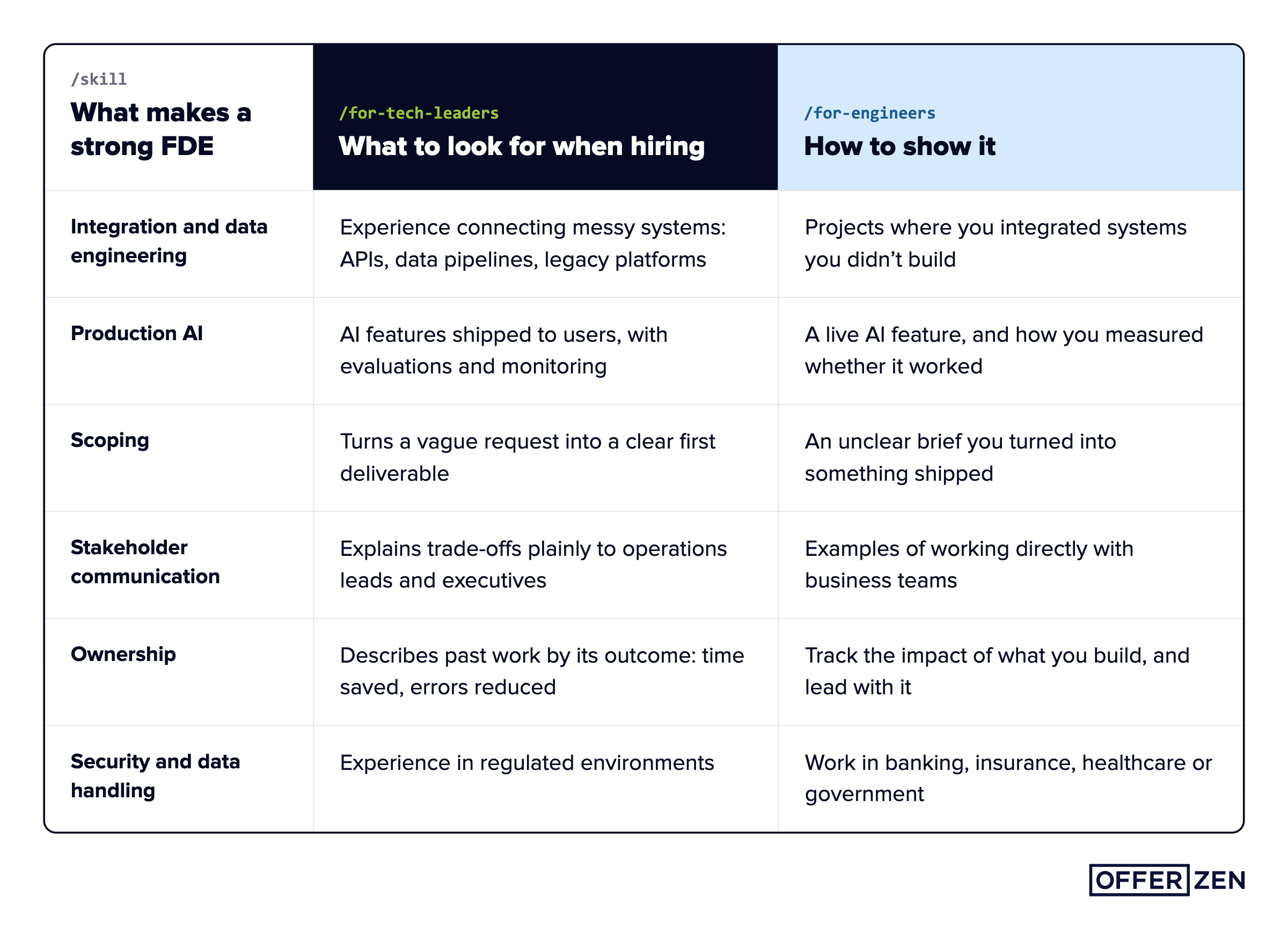
Domain knowledge is a strong advantage. An engineer who understands how a bank or insurer operates can scope a project faster and build trust sooner.
Data engineers with analytical backgrounds and sales engineers with deep industry experience are among the profiles moving into FDE roles successfully.
How do you hire a forward deployed engineer?
Look for the overlap between engineering depth and business judgement, and make sure your interview process tests both. FDE interviews often go beyond coding challenges or take-home assessments, with case studies and customer simulations designed to see how candidates think through real-world problems.
A strong interview process should cover four areas:
- A practical integration task. Ask candidates to connect two systems, or an AI model to a messy dataset, while working within realistic constraints.
- A scoping exercise. Give them an ambiguous customer request and see how they break it down, identify the key problems and decide what to build first.
- A stakeholder conversation. Ask them to explain a technical trade-off to someone without an engineering background.
- A deployment that went wrong. Ask what happened, how they handled it and what they'd do differently next time.
For UK companies looking to hire FDEs, South African software engineers are a strong talent pool to tap into.
Many are used to working in smaller teams, collaborating directly with the business and taking ownership of outcomes. Add the time zone overlap with the UK and Europe, and real-time collaboration is easy.
How do South African engineers become forward deployed engineers?
The role is already making its way into South Africa. AWS used its Johannesburg Summit in August 2026 to introduce its new $1 billion FDE business to African enterprises. Salesforce, PwC and local AI companies have also advertised FDE roles in Johannesburg and Cape Town.
South African engineers also bring relevant experience to the table. Many already work in smaller teams, where they deal directly with stakeholders, own outcomes, and make pragmatic trade-offs. That's a pretty good foundation for the FDE role.
There are three realistic routes into the role:
- Local FDE roles. SaaS and AI companies are building teams to deploy their products into South African banks, insurers, retailers and telcos.
- Remote roles at global companies. The time zone overlap with Europe makes working for international teams much easier from South Africa.
- A move from a related role. Solutions engineers, data engineers and technical consultants already have a lot of the skills FDEs need, so it's a pretty natural next step.
Frequently asked questions
1. What job titles are similar to forward deployed engineer?
You'll find similar roles advertised under different titles, depending on the company. Look out for forward deployed software engineer, deployment engineer, applied AI engineer, field engineer and solutions architect. The titles can be a bit all over the place, so read the job description. If you're writing production code inside customer environments, you're probably looking at FDE work.
2. Is the FDE role all about AI, and do you need AI experience?
AI is what's driving the demand for FDEs, but the job itself is about getting products into production. Palantir created the role for its data platform long before generative AI came along, and companies like Salesforce still hire FDEs to work on non-AI products.
That said, most new opportunities involve AI in some way. Experience shipping things like agents, retrieval systems or evaluations will give you an edge. But strong integration and data engineering skills are still the foundation, so you don't need to be an AI expert to get started.
3. Is FDE a good career move for South African engineers?
If you enjoy working with people as much as writing code, it could be a great move. FDE roles are already popping up in Johannesburg and Cape Town.
The mix of engineering skills and business judgement can also open doors to senior engineering, product and leadership roles down the line.
And there's a financial upside to building AI skills: 36% of South African developers already say they've improved their earning potential by doing so.
Hiring an FDE, or looking for your next role?
For hiring managers: You can now find and hire forward deployed engineers on the OfferZen marketplace. Need a hand with the hiring process? OfferZen Recruiter gives you a dedicated Talent Partner to handle the heavy lifting, with the option to add custom role-specific technical vetting.
For engineers: Companies hiring FDEs want to see what you can actually build and ship. Use your OfferZen profile to show them. Add your projects and how you use AI in your work, then put "Forward Deployed Engineer" in your preferred roles section. Hiring managers get a sense of your technical judgement and can see you're interested in the role. They can then send you interview requests, with the salary upfront.