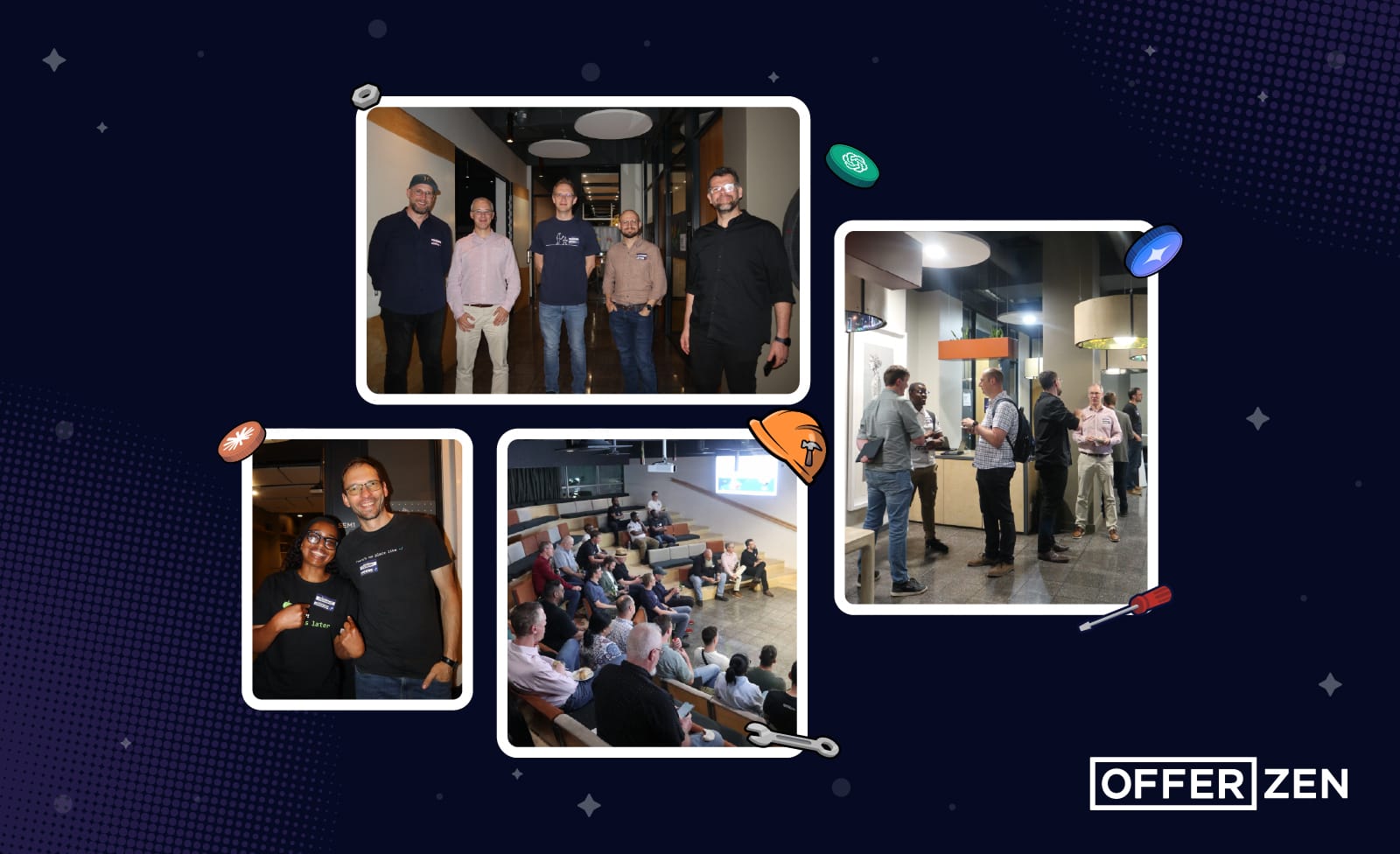
Joburg is home to some of the country’s biggest engineering teams. On 15 October, we took the Tech Leader Exchange there for the first time and gathered 32 engineering leaders to talk about how their teams are working with AI.
Leaders from companies like Absa, Dis-Chem, Lula and Cars.co.za shared what’s happening inside their teams, from getting AI tools past security sign-off to keeping up with the code those tools produce.
Gavin Emes, OfferZen’s Head of Sales, opened the evening with the AI-enabled engineering framework our product team developed. From there, we broke into roundtable groups for peer-to-peer discussions about what’s working, where teams are stuck, and what others are doing to move forward.
Here’s the framework, along with the key takeaways from those conversations.
OfferZen’s AI-enabled engineering framework
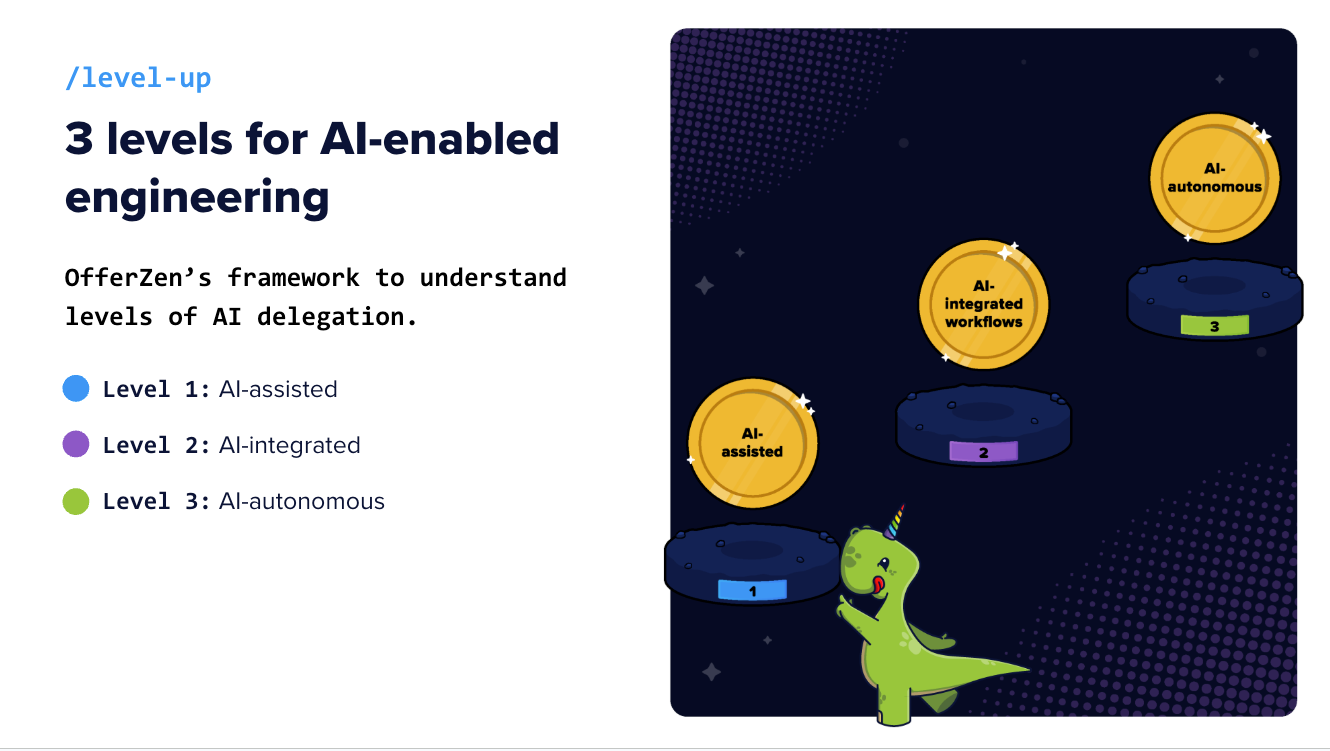
The framework maps out three levels of AI adoption: AI-assisted, AI-integrated and AI-autonomous.
Level 1: AI-assisted.
At this level, you’re still in the driver’s seat for the full workflow. A good shorthand: one prompt in, one response out. You might get a task done faster, but nothing is set up to be repeatable or scalable.
Level 2: AI-integrated.
Here’s where you start to see real productivity gains. You're embedding AI into an existing process so that a scoped task gets completed in a consistent, repeatable way. You're still steering and reviewing, but you've handed the execution to AI in a structured way.
Level 3: AI-autonomous
Now the focus moves from single tasks to full multi-step processes. You're creating the conditions for agents to move through several stages of work independently: discovery, execution, and even self-correction. Your job is to frame the problem, set up the environment, and step in with your judgement when it matters.
Keep in mind
A team isn’t simply at one level. Different kinds of work can sit at different levels depending on the risk involved, how clearly the work is defined, and how much context your AI agents have. And while we’re talking about engineering here, the same framework can apply to product, design and data teams.
So, what’s the real question at each level?
How much of the work are you handing over to AI? Is it a single small task, one step in a wider process, or the whole process?
Does every task need to reach level three?
Not at all. The goal is to be intentional about where different types of work belong, and to adjust as your team’s confidence grows and your AI capabilities evolve.
6 key takeaways on AI-enabled engineering
Across four roundtable groups, these were the key insights that came through.
1. Senior engineers are adopting AI the fastest
Across the rooms, senior engineers were often furthest along in adopting AI. Several engineering managers said their most experienced engineers were already working closest to Level 3, while the rest of their teams were still building confidence and learning how to integrate AI into their workflows. One engineering manager had expected his older engineers to be more cautious, but found they were actually the first to embrace it.
“If the team’s more mature, I feel the adoption is just easier.” – Participant
Experience gives senior engineers an advantage with AI. They know what good work looks like, which helps them give AI clearer instructions and spot when its output misses the mark. One cybersecurity engineering manager said AI agents produce noticeably better results when a senior engineer sets up the task. Teams with more experienced engineers also found it easier to adopt AI across their workflows.
“Seniors are definitely flying.” – Participant
2. Hiring and the junior-to-senior path are under pressure
Engineering managers are increasingly concerned about where the next generation of senior engineers will come from. Junior engineers traditionally developed their judgement by making mistakes, fixing them and learning from the process. AI can now bypass much of that hands-on experience. Some companies would rather wait six to nine months for an experienced, AI-capable senior engineer than hire a junior. One team took on just one intern this year and has no plans to hire any next year.
“I think in three to five years, we might have a massive skill shortage and demand for senior people.” – Participant
Some engineering managers are finding ways to keep junior engineers learning. One tech lead holds roundtables twice a week where juniors explain their decisions and how they used AI, making their reasoning visible. Others noted that graduates with strong academic backgrounds often want to understand problems from first principles rather than jump straight to an answer.
Hiring is becoming more difficult, too. Take-home assessments are coming back with polished, AI-generated solutions that candidates struggle to explain. One team has redesigned its technical assessment three times in a year. Another caught a candidate reading AI-generated answers aloud during a video interview.
Engineering managers are responding with in-person interviews, live pairing on real projects and more referrals. They also see a need to rethink job specs: years of experience in a particular language matter less than the ability to reason through a problem.
“I can’t judge the guy’s code. He wrote none of it. But his practice impressed me.” – Participant
3. Review is now the bottleneck, and accountability still sits with people
Every room described the same shift: AI is speeding up code production, leaving teams with more code to review and less time to scrutinise it. Pull requests are getting larger, and reviewers are struggling to give each one the attention it needs. One engineering manager now uses AI to map where most of a 30,000-line change sits before diving into the code. Several engineering managers also pointed out that AI-generated code can pass every test and still fail to deliver what the feature was meant to do.
Teams are introducing extra checks to manage the volume. Some run a second AI agent in a separate session to challenge the first agent’s work. Others are tightening automated quality checks so code must meet the required standards before it ships.
“The AI is really good at solving the easy 80% of the problem you give it. You need to make sure it’s solving the rest of it.” – Participant
The person committing the code remains responsible for its quality, regardless of how much AI contributed. Engineering managers are concerned that some junior engineers accept AI-generated output without questioning it. One firm even let a consultant go for submitting large amounts of AI-generated code without reviewing it first.
“The machine cannot be accountable. You can’t sanction the machine, so there always has to be a human who is.” – Participant
4. Teams can now build faster than their customers can absorb
One team of 35 engineers grew revenue by 40% this year without adding headcount, and still has capacity to do more. This raises a question engineering managers are grappling with: how should teams use the extra capacity AI creates?
Building faster doesn’t mean customers need more features. A bank can’t simply add several times more features to its app because engineers can build them faster. Customers can only absorb so much change. Challenger banks may move faster than those running decades-old systems, but they face the same limits on how much new functionality customers actually need.
“There’s a point where we’ve probably built everything the market can handle right now.” – Participant
Some teams are using the extra capacity to explore more ideas before committing to a build. They have more time to test possibilities, weigh up different approaches and decide which ideas are worth pursuing.
“Clients come to us and say, have you built AI into the app? And we ask, what problem are you trying to solve? Does it have to be AI?” – Participant
5. Engineering now needs to help everyone else build safely
AI is giving people across the business the ability to build their own tools, even without engineering skills. One accountant cut a daily five-hour task down to ten minutes through automation. A product manager built an AI review panel trained on his senior engineers’ past code reviews, helping him ship work at a quality level close to theirs.
“We’re calling it personal software. People are running things they wrote themselves that they’ll never share with anyone else.” – Participant
This easier access to AI tools also brings security risks. At one large company, a senior finance executive built an AI-powered tool connected to the company’s financial systems, but left it open to anyone with a Microsoft account. Security testers at the event said they’re seeing these kinds of basic security mistakes far more often.
So what are engineering teams doing to manage the risks? They’re making it part of their job to give others safe ways to build. One company gives support staff read-only access to the codebase, so they can investigate problems without changing anything. Another provides a shared framework for teams to build their own quality checks. A consultancy creates controlled environments where product teams can experiment freely, while engineers review and audit what they build.
“We deployed harnesses in a couple of clients’ businesses, and it lets their product people build freely. We come in, review the system and run our audits.” – Participant
6. Teams are filling the time AI saves with more work
One leader recalled a line from a conference talk that stuck with the room: time saved is never banked. Teams are saving hours with AI, but that time is going straight back into more work. Engineers now spend their days reviewing AI-generated output and managing three or four agents at once. When one senior developer cut a two-week build down to three days, the business immediately asked what else he could take on. Others are using the extra time to tackle work that was previously beyond their reach, making it harder to switch off.
AI-assisted work can feel so productive that people struggle to know when to stop. Engineering managers also pointed to pressure from the business, where increased AI usage is expected to translate into more output. Junior engineers feel this particularly strongly. They once had time to learn the domain before taking on full responsibility; now, they're expected to hit the ground running from day one.
“We’re able to move much faster now, so there should be more breathing room. But it doesn’t feel that way.” – Participant
Some teams are setting clearer boundaries. One requires engineers to switch off their machines at the end of the day, while another follows two-week sprints with two weeks of rest. A team that initially pushed hard on AI adoption changed direction after a few months, prioritising consistent, sustainable work over speed.
Others are finding ways to reduce the mental load of working with AI. One team simplifies AI-generated output before it goes for review. Another uses a command to summarise the goal of an AI session, helping engineers pick up where they left off without rereading the entire conversation.
“Burnout isn’t self-directed. It’s when there’s an external party driving those actions.” – Participant
One engineering manager shared an analogy that stuck with the room: an LLM can teach itself to play better chess, but it won’t decide to play Monopoly. AI can improve how we build, but people still decide what’s worth building and take responsibility for what goes out the door.
Interested in joining an upcoming Tech Leader Exchange in Cape Town or Joburg? Join the waitlist, and we'll be in touch when the next one is coming your way.