Lego block with tools on itLego block with a money bag on itLego block with a magnet on itLego block with ai robot on itLego block with money note on it

/STATE-OF-SOUTH-AFRICAS-DEVELOPER-NATION

2026 Salary and benefits report

AI, lean teams, and rising expectations are reshaping what it means to grow in tech. 2,200+ software professionals weigh in on pay, perks, and the career moves that matter most.

AI, lean teams, and rising expectations are reshaping what it means to grow in tech. 2,200+ software professionals weigh in on pay, perks, and the career moves that matter most.

Download the reportDinocorn floating

The rules on pay, progression, and performance are changing.

AI is raising the bar. Teams are hiring more selectively. Developers are evolving faster than the systems designed to support them.

2,200+ software developers, data professionals and tech leaders share how pay, progression, and hiring are evolving as expectations rise and the gap between AI tools and capability is starting to show.

49%
of developers feel underpaid with juniors feeling it most
36%
report increased earning potential thanks to AI
50%
say AI frees them up for more strategic tasks

Get the full insights from 2,200+ tech professionals in South Africa 🇿🇦

Download the report

#section-1

/salary-growth

/salary-growth

Salaries in tech have stabilised with only senior developers seeing the strongest growth. While AI skills are beginning to influence earnings for some, the overall impact on salary trends is still emerging.

49% of devs feel underpaid, with juniors feeling it most at 62%
How do you feel about your current compensation?
Underpaid
Fairly paid
Overpaid
Entry level
53.2%
Junior
61.5%
1.0%
Intermediate
Interm.
53.5%
0.8%
Senior
43.6%
2.9%
Tech Lead
45.0%
3.3%
Executive
39.3%
2.4%
“Salary conversations are difficult because they sit at the intersection of money, power, and self-worth."
- Anonymised survey respondent

Lego silver with R1 coin

#section-2

/benefits-and-perks

/benefits-and-perks

Retention is becoming a bigger priority as teams stay lean and expectations rise. Understanding which benefits developers value most, and where current offerings fall short, is key to keeping teams engaged and supported.
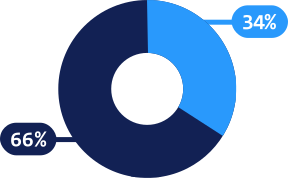
34%
of developers say their
benefits match their needs
Graph
“What employees really value in benefits isn't always what looks great in a slide deck.”
- Anonymised survey respondent

Top 3 benefits wish list

1

Performance & annual bonuses

2

Pension or retirement contribution

3

Learning & development budget

#section-3

/hiring-and-retention

/hiring-and-retention

Engineering teams are evolving in an AI-driven world. Companies are keeping teams lean, hiring more intentionally, and focusing on retention: prioritising keeping the right people over sheer headcount.

Factors limiting hiring
Budget constraints
40%
Lack of suitable candidates
20%
Internal approval or prioritisation
15%
Hiring speed or process
9%
Reduced internal hiring or recruitment capacity
7%
Business instability
4%
Expectations to increase output using AI before hiring
3%
"I'm finding it harder and harder to find good engineers who care about understanding the underlying concepts."
- Anonymised survey respondent

Lego block with graph on itLego block with a magnet on it

#section-4

/career-progression

/career-progression

Developers are evolving faster than the frameworks designed to support them. With repetitive tasks automated, more time is shifting toward high-value work — creating both new opportunities and new gaps in how progression is defined.
Graph
44%
of developers have invested time in learning or adopting AI tools to stay competitive
“AI, product thinking, and system design are becoming core — coding is just one part of the job now.”
- Anonymised survey respondent
“The real shift is toward higher level thinking – systems, strategy, and problem solving over syntax.”
- Anonymised survey respondent
"My ability to work with AI has positively affected my earning potential"
Disagree
Neutral
Agree
20%
36%
“The real shift is toward higher level thinking – systems, strategy, and problem solving over syntax.”

Stay in the loop with the lastest data.
In your inbox every 2 weeks.

/STATE-OF-SOUTH-AFRICAS-DEVELOPER-NATION

2026 Salary and benefits report

A practical snapshot of how pay, progression, and benefits are shifting in South African tech — based on 2,270 real responses from software and data professionals, so you can benchmark with confidence and make informed career or hiring decisions.

Get actionable insights on:

  • Where salaries actually sit across roles, seniority, and tech stacks

  • What developers value in benefits — and where packages fall short

  • How AI is impacting earning potential and career progression

  • What competitive hiring and retention looks like in today’s market

salary-and-benefits-report-2026
Data Reports
download form
Download Resource
Downloaded Resource
2026 Salary and Benefits Report
content
Content
Download the report
Are you hiring developers?
Want to see how OfferZen can accelerate your developer hiring?
ReCAPTCHA failed, please try again.
Oops! Some info seems incorrect. Please review your info.
Thank you! Your submission has been received!
Oops! Something went wrong while submitting the form.
Why do I have to give my info?
Info
We will never share your information or send you emails without your consent. This information enables us to send you the report, capture performance analytics, and give you the option to opt-in to more high value content via our OfferZen newsletters.

/how-to-use this-data

The report gives you a snapshot of market salaries, but numbers alone aren’t enough. Whether you’re a leader planning your team’s growth or a developer thinking about your next move, this data is most powerful when it sparks informed, confident conversations. We’ll help you navigate those discussions and turn insights into action.

About OfferZen

OfferZen is South Africa's largest tech talent marketplace that connects job-seeking software, product, and data professionals with exciting opportunities at over 2000 companies.

Smiling green dinosaur with a rainbow unicorn horn flying in space with stars and planets in the background.

Methodology

OfferZen surveyed developers, data professionals, and tech leaders between 1-30 February 2026 to understand what’s really happening inside South African tech teams. More than 3,500 people responded, with 2,270 responses deemed valid for analysis.

We hosted the survey on Typeform and recruited respondents via email sent to more than 40,000 members of the OfferZen community, as well as through social media posts. Data was anonymised in accordance with GDPR guidelines and is housed separately from any and all of OfferZen’s platform data. Percentages may not always add to 100% due to rounding.

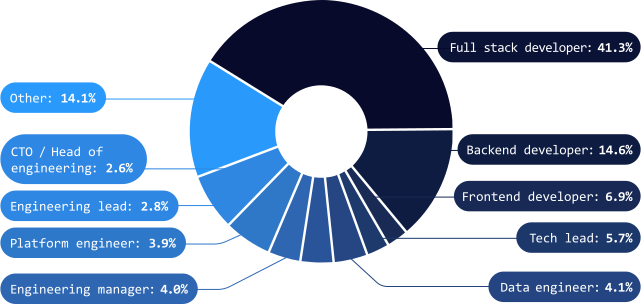
Their role
Methodology job title

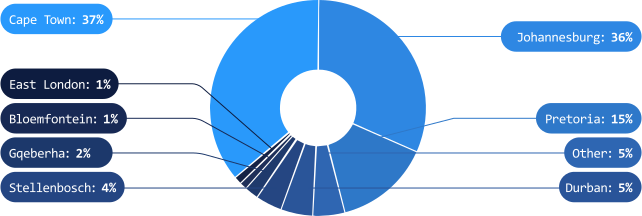
Their city

Methodology location

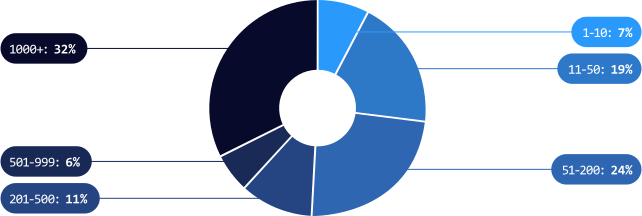
Their company size

Methodology company size

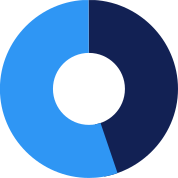
Their gender

Graph for gender split

Survey questions

Responses to the following questions were used in the 2026 State of the Developer Nation: Salary survey.

Salary and compensation

Money talk ahead. Transparency only works if we’re honest.

For rating-based questions, respondents were asked to select 1 if they strongly disagreed with the statement, 3 if they were neutral, and 5 for strongly agreed.

In what bracket is your current monthly salary (cost to company, before tax)?

R0 -  R10,000
R10,001 - R15,000
R15,001 - R20,000
R20,001 - R25,000
R25,001 – R30,000
R30,001 - R35,000
R35,001 - R40,000
R40,001 – R45,000
R45,001 - R50,000
R50,001 - R55,000
R55,001 - R60,000
R60,001 - R65,000
R65,001 - R70,000
R70,001 - R75,000
R75,001 - R80,000
R80,001 - R85,000
R85,001 - R90,000
R90,001 - R95,000
R95,001 - R100,000
R100,001 - R110,000
R110,001 - R120,000
R120,001 - R130,000
R130,001 - R140,000
R140,001 - R150,000
R150k+

How do you feel about your current compensation?

I feel underpaid
I feel fairly paid for my role and experience
I feel overpaid

When does your company review or apply salary increases?

Annually (fixed cycle)
Bi-annually
Quarterly
At performance review time (no fixed schedule)
Ad hoc / as needed
Inflation / cost-of-living adjustment
Other

What was your most recent annual salary increase?

1–3%
4–6%
7–10%
11–15%
More than 15%
Not applicable (too new in the role or other reason)
I did not receive an annual increase

Did you receive an annual bonus?

Yes
No

What was the value of your bonus?

Free text

In the last year, which of the following describe how you’ve approached job decisions or actions?

I’ve looked for additional income streams (e.g. freelance work)
I’ve been more open to working for international companies remotely
I’ve accepted pay trade-offs to secure work
I changed jobs in the last 18 months and now earn more
I've prioritised job stability over compensation growth
I’ve invested time in learning or adopting AI tools to stay competitive
I've felt pressure to prove my value as AI tools become more capable
AI tools have allowed me to shift focus toward product thinking, architecture, or strategic work
None of the above

My ability to work with AI-related tools or concepts has positively affected my earning potential.

1
2
3
4
5

In what ways, if any, has AI influenced your compensation, opportunities, or sense of job security?

Free text

Benefits and perks

The extras that quietly make work better (or don’t).

For rating-based questions, respondents were asked to select 1 if they strongly disagreed with the statement, 3 if they were neutral, and 5 for strongly agreed.

I find my benefits package useful and relevant to my needs.

1
2
3
4
5

Which monetary benefits do you currently receive?

Allowances (internet, cellphone, travel, etc)
Performance or annual bonuses
Parental leave package (maternity, paternity, adoption)
Learning and development budget
Childcare benefit
Medical aid contribution
Pension / retirement contribution
Stock options or shares
Sign-on / joining bonus
None of these
None of these

When evaluating a potential role, which monetary benefits matter most to you? Choose 2-4 options

Allowances (internet, cellphone, travel, etc)
Performance or annual bonuses
Parental leave package (maternity, paternity, adoption)
Learning and development budget
Childcare benefit
Medical aid contribution
Pension / retirement contribution
Stock options or shares
Sign-on / joining bonus

If available, what would you spend your Learning & Development budget on in 2026?

Online courses (e.g. self-paced platforms)
Technical certifications
Conferences or meetups
Workshops / bootcamps
Books or learning subscriptions
Mentorship or coaching
Side projects / experimental tooling
Courses or training focused on AI-assisted coding tools
Other

Which perks and benefits do you currently receive? Choose all that apply

Remote or hybrid work
Flexible working hours
Unlimited PTO / generous leave policies
Sabbatical opportunities
Birthday leave
Conference attendance & speaking opportunities
Resources to work on personal projects
Wellness programs (gyms, mental health support)
Mentorship programs / career coaching
Weekly team meals
Birthday / anniversary budget or gift
Team events & offsites
Long service awards like extra leave days, paid trips
Budget for remote set up equipment
Other

When evaluating a potential role, which perks and benefits matter most to you?

Remote or hybrid work
Flexible working hours
Unlimited PTO / generous leave policies
Sabbatical opportunities
Birthday leave
Conference attendance & speaking opportunities
Resources to work on personal projects
Wellness programs (gyms, mental health support)
Mentorship programs / career coaching
Weekly team meals
Birthday / anniversary budget or gift
Team events & offsites
Long service awards like extra leave days, paid trips
Budget for remote set up equipment
Other

How many paid leave days do you get per year?

Exactly the statutory minimum (15 days)
16–20 days
21–25 days
25–30 days
More than 30 days
Unlimited

I value flexibility (remote work and flexible hours) more than salary increases.

1
2
3
4
5

What do you think most companies are getting wrong about benefits in tech?

Free text

Career progression

The stuff that decides whether you’re levelling up or just looping.

For rating-based questions, respondents were asked to select 1 if they strongly disagreed with the statement, 3 if they were neutral, and 5 for strongly agreed.

Do you have a career progression framework for your role?

Yes — clearly defined and documented
Yes — but informal or loosely defined
No — there is no clear progression framework
Not sure

I clearly understand what is required to progress to the next level in my role.

1
2
3
4
5

How often do you receive feedback from your manager that helps you improve your performance?

Weekly
Once every two weeks
Once or twice a month
Quarterly
A few times a year
Rarely or never
Not applicable (e.g. no direct manager)

My manager can effectively support my career progression.

1
2
3
4
5

What shapes how much you trust a manager to support your career progression?

They understand my role and the work I actually do
They’re clear on how progression works and what’s required to level up
They give specific, actionable feedback I can act on
They’re informed about market ranges and internal pay bands
They actively advocate for me when it comes to raises or promotions
They help me access relevant training or learning opportunities when I need them
They assign or support challenging projects that stretch my skills
They’re transparent about earning potential and what influences it over time
They create opportunities to work with new languages, frameworks, or technologies
Not applicable (e.g. no direct manager)

When thinking of a good manager, what matters most to you?

Pay decisions that are fair and transparent
Feedback that actually helps me get better
Clear expectations, not moving goalposts
A manager who actively backs my growth, not just approves it
Honest conversations, including the uncomfortable ones
Consistent treatment across the team (no favourites)
A manager who removes obstacles so the team can do their best work
Not applicable (e.g. no direct manager)
Other

How do you primarily benchmark whether your salary is fair?

Salary reports (e.g. OfferZen, industry reports)
Comparing with peers in similar roles
Recruiter outreach or job offers
Online research (forums, LinkedIn, Glassdoor, etc.)
Asking AI / LLMs (e.g. ChatGPT) about market salary
I don’t actively benchmark my salary
Other

How confident do you feel negotiating your salary?

Confident
Somewhat confident
Not confident

What makes the salary conversation difficult?

Free text

Choose your top 3 reasons for staying at a job

Competitive pay and clear earning potential over time
Challenging, meaningful work that keeps me learning
Clear paths to growth, progression, and increased responsibility
A manager I trust and can have honest conversations with
The chance to work with modern tools, languages, or frameworks
Autonomy over how I do my work
Work-life balance that’s actually respected
Job security and business stability
A team I enjoy working with and can learn from
Flexibility (remote work, hours, location)

I feel that the performance metrics used to evaluate my work are still relevant in the age of AI.

1
2
3
4
5

Which best describes how AI has changed your work?

It has significantly increased my productivity
It has freed up time for more strategic or higher-value work
It has slightly improved my productivity
It hasn’t meaningfully changed how I work
It has made some of my work less visible or less valued
I’m not using AI tools in my work

What’s one thing your manager does — or doesn’t do — that has the biggest impact on your growth or progression?

Free text

Which best describes your current scope of responsibility at work?

Individual Contributor – I have no direct reports. My role is hands-on delivery (e.g. developer, designer, analyst).
Team Lead – I do hands-on work but also manage 1+ people directly.
Manager – I manage a team and spend most of my time on people management rather than individual delivery.
Manager of Managers – I manage managers who each lead their own teams.
Executive – I’m part of the executive leadership (e.g. VP, CTO, Head of Function).

Hiring and retention

How it actually feels to build, reward and keep a team right now.

For rating-based questions, respondents were asked to select 1 if they strongly disagreed with the statement, 3 if they were neutral, and 5 for strongly agreed.

How is your data or engineering team’s headcount likely to change in 2026?

Decrease
Stay about the same
Increase by 1–2 engineers
Increase by 3–5 engineers
Increase by more than 5 engineers
Not sure yet

Which of the following best describes your team’s situation in 2026?

We expect higher productivity per engineer than in previous years due to AI
We feel pressure to hire more senior engineers due to leaner teams
Retention is a bigger concern for us than hiring
AI fluency and product thinking are now baseline expectations for engineers
Hiring is focused on filling specific, high-impact roles rather than broad team growth
Hiring has become more reactive than proactive
We’ve had to adapt our performance or evaluation frameworks in response to AI
Not applicable

What is the biggest factor limiting your ability to hire in 2026?

Budget constraints
Lack of suitable candidates
Internal approval or prioritisation
Business instability
Reduced internal hiring or recruitment capacity
Hiring speed or process
Expectations to increase output using AI before hiring more people
Hiring is not constrained

How much control do you have over compensation decisions (such as salary increases and bonuses) to reward performance in your team?

Full control within an approved budget
Some influence, but final decisions sit elsewhere
Very limited influence
No real control
Not applicable

How do you typically benchmark salaries for roles in your team?

Industry salary reports (e.g. OfferZen, market surveys)
Internal pay bands or frameworks
Recruiter feedback or candidate expectations
Counteroffers or retention cases
Peer managers at other companies
I don’t actively benchmark salaries
Other

What makes salary conversations most difficult for you as a manager?

Limited budget or headcount constraints
Lack of clear salary bands
Market volatility / unclear benchmarks
Misaligned expectations from team members
Decisions being overridden by leadership
Performance signals being unclear
I don’t find salary conversations difficult

Which best describes performance reviews in your team?

Clear goals, regular feedback, and clear links to pay or progression
Clear feedback, but limited impact on pay
Reviews happen, but mostly as a formality
Inconsistent or rushed
We don’t really do structured performance reviews

How much influence do you personally have over how AI is adopted in your team?

Full ownership and decision-making authority
Significant influence, shared with others
Some input, but limited control
Very little influence
No influence at all

Have you felt a need to change the performance metrics used to evaluate your team in the age of AI?

Yes — significantly
Yes — slightly
No — our current metrics still work well
Not sure / too early to tell
We haven’t discussed this as a team

What's something about salary or progression decisions that you find yourself explaining repeatedly to your team?

Free text

Company, industry and skills

Last stretch. Just a few basics about your company, industry and skills, then you’re done.

For rating-based questions, respondents were asked to select 1 if they strongly disagreed with the statement, 3 if they were neutral, and 5 for strongly agreed.

How large is your engineering or data team?

Just me
2–5 people
6–10 people
11–20 people
21–50 people
51+ people

How large is your company?

1–10 employees
11–50 employees
51–200 employees
201–500 employees
501-999 employees
1000+ employees

What industry is your company in?

Blockchain
Automation and Robotics
Cloud-based solutions or sevices
Consulting
Digital agency or services
Industrial IoT (Internet of Things)
Data and analytics
Risk Management and Cybersecurity
EdTech
HealthTech
FinTech
MarTech
Media, advertising, publishing, or entertainment
Retail or eCommerce
Risk Management and Cybersecurity
Software as a Service (SaaS) development
Telecommunications
Travel and hospitality
Renewable Energy / Sustainability
Gaming
Higher education
Non-profit / NGO
Web development or design
Energy / mining / utilities
Real estate / PropTech
Other

Which of these languages do you actively use in your current role?

JavaScript
TypeScript
Python
Java
C#
PHP
Go
Ruby
C / C++
Kotlin
Swift
Rust
Scala
Lua
Elixir
Dart
R
SQL
Bash / Shell scripting
I manage/lead a team (no regular coding)

Which skills are becoming more important in your role?

Free text