“The bottlenecks have changed. We moved from producing code to judging it.”
That’s how Andrew Considine, CPTO at Pollinate, describes what it means to be a software engineer today. As AI transforms software development, engineers are creating value in new ways.
The most in-demand software developer skills are evolving alongside that shift. Half of developers say AI is already pushing their work toward higher-value, more strategic tasks. Meanwhile, 71% of engineering teams are focusing on building high-impact capabilities instead of simply hiring more people.
So, which skills actually matter most? We spoke to more than 60 engineering leaders and hosted a deep-dive panel discussion with tech leaders from impact.com and Pollinate.
Here are the capabilities they kept coming back to – the ones that set great software engineers apart today.
What are the most in-demand software developer skills?
These are the capabilities tech leaders are increasingly looking for when hiring and growing engineering teams.
1. AI fluency
AI fluency is the ability to use AI tools effectively to solve software engineering problems. For developers, it’s more than typing prompts into an AI assistant or clicking “accept” on code suggestions. It’s about building AI workflows (or “AI harnesses”) that combine the right prompts, context, tools, and guardrails to consistently produce reliable results.
As Tian Schoeman, AI Productivity Manager at impact.com, explains: “It’s something that differentiates people very quickly: someone who’s just using AI without understanding how the underlying mechanics work, versus someone who understands the tools and documentation well enough to actually steer it. Read the manual, understand the tools. AI isn’t going to just get stuff done for you.”
Good to know: AI fluency now has its own dedicated section on OfferZen candidate profiles, giving hiring teams more visibility into how developers use AI in practice.
2. Judgement
Using AI effectively is only half the equation. True AI fluency also requires judgement. AI can confidently generate code, suggest solutions, and answer technical questions in seconds, but it can’t tell you whether those answers are actually right for your system, your users, or your business.
Without that judgement, it’s easy to ship code that’s technically sound but no different from what everyone else is producing. This is where experienced developers learn to defend their worldview. Rather than accepting AI’s suggestions at face value, they apply their understanding of the architecture, business context, and technical constraints to decide what to accept, adapt, or reject.
Andrew sees this as the key differentiator: “The engineers who will thrive in the AI era are the ones who can separate confident answers from correct ones.”
Good to know: Judgement is quickly becoming a top skill evaluated in technical assessments. More and more companies care less about whether you used AI to write your code and more about whether you can explain your choices, defend your trade-offs, catch mistakes, and own the final outcome.
3. Systems thinking
Systems thinking is all about seeing the big picture. Change one thing, and you might set off a chain reaction across services, dependencies, teams, user experience, security, and even business results.
Sure, AI can whip up a quick fix for a local issue, but developers still have to think ahead, weigh the trade-offs, and make choices that keep the whole system running smoothly.
As Andrew puts it: “It used to all be about what somebody could do with a keyboard. Now we’re really hiring people to look at things with ownership and become the architect.”
4. Product-mindedness
Product-mindedness means understanding your customers, your business, and your industry well enough to solve the right problem.
As AI accelerates implementation, developers create the most value by identifying the right problem, not just building the requested solution. Product-minded developers ask tough questions, challenge assumptions, and make better decisions because they understand the customer, the business, and the context AI can’t.
As Andrew frames it: “The reality is the majority of back-end tech for all verticals is pretty much the same these days... where the nuance is that understanding of the industry, knowing how things operate within the domain that we’re in, and importantly, how customers are operating within that as well.”
For example, imagine you’re working on a fintech product. A ticket asks you to build a notifications feature to remind customers about failed payments. Rather than jumping straight into implementation, you ask why payments are failing in the first place. You discover the issue is confusing authentication during checkout, not a lack of reminders. Because you understand both the customer journey and the payments domain, you improve the checkout flow instead of adding another notification.
5. Communication and collaboration
Communication and collaboration are about clearly explaining ideas, aligning with others, and influencing decisions throughout the software development lifecycle.
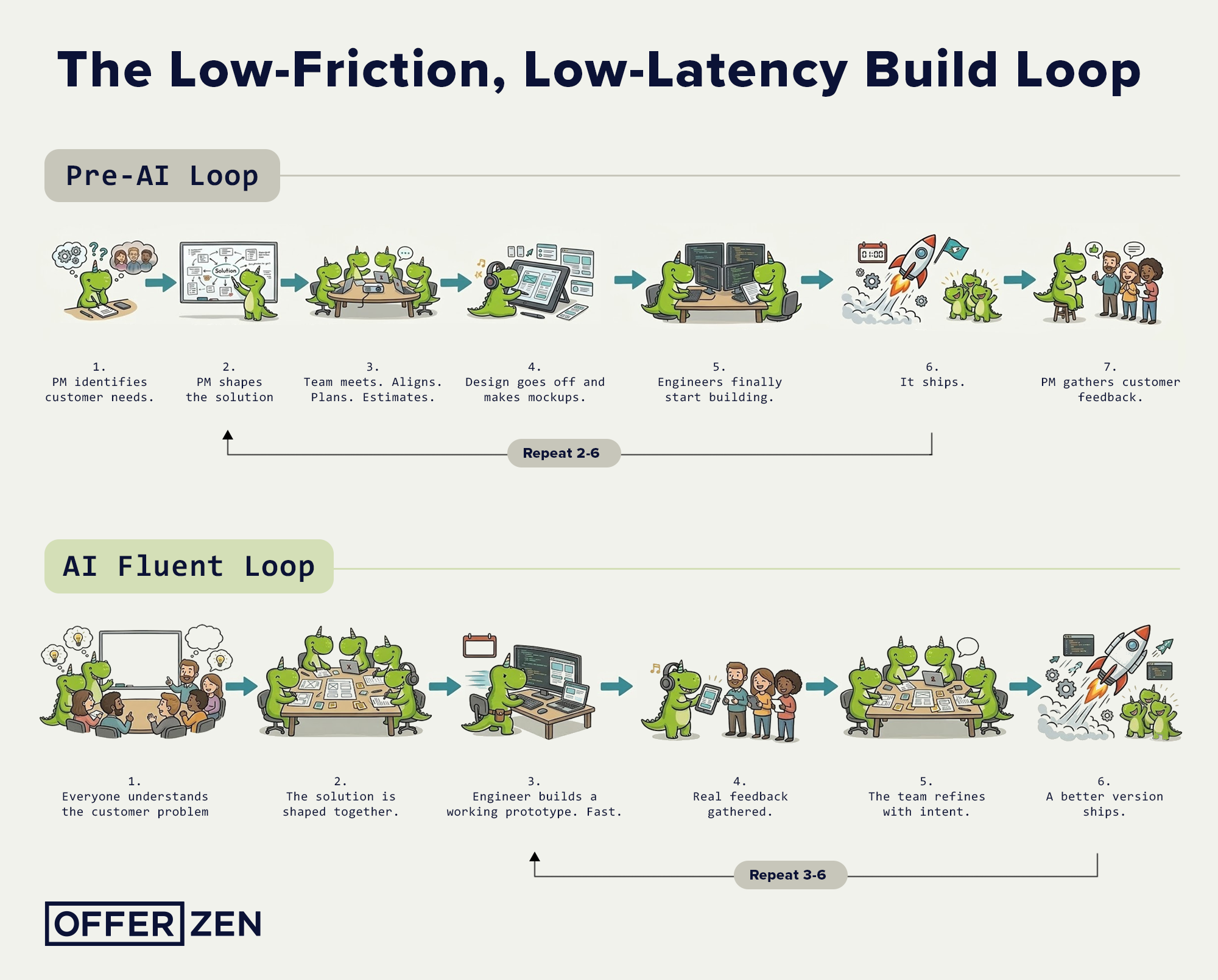
The software development lifecycle itself is changing. Gone are the days of endless handoffs between product, design, and engineering. Now, teams work together from the start, prototype quickly, and get feedback fast. Developers aren’t just handed tickets anymore. They’re shaping solutions with product managers, designers, customers, and yes, even AI.
As one engineering leader at an OfferZen Tech Leader Exchange put it, “the coding language of the future is English.” If you can’t clearly explain the problem, your trade-offs, or what success looks like–to your team or to AI–you’ll struggle to build the right thing. Communication is no longer a soft skill. It’s a core engineering skill.
6. Ownership
Once you’re helping shape decisions, ownership becomes the skill that ties everything together. AI fluency helps you move faster. Systems thinking helps you navigate complexity. Product thinking helps you solve the right problem. Communication helps you influence others. Ownership is what brings it all together.
Today’s engineering leaders are looking for more than developers who can work through a backlog. They want people who step up, question assumptions, and own the outcome, not just the task.
As another engineering leader explained, “We’re not looking for AI to do everything... we’re hiring people with curiosity, an engineering mindset, and ownership.”
7. Curiosity and adaptability
Curiosity and adaptability are about staying open to change and continuing to learn. Every major shift in software development has created new tools, new ways of working, and new opportunities. AI is no different. The engineers who thrive won’t necessarily be the ones who know every new framework or AI tool today; they’ll be the ones who keep learning as the technology evolves.
Hiring managers want to see that you love learning, experimenting, and building things. Maybe that’s a side project, tinkering with new tech, contributing to open source, or just building something because you’re curious:
“That’s always been what I check for. I know you’re curious if I go to your GitHub page and see 50 repos you’ve built. That’s what I want to see.”
This mindset is what the Apprentice AI Engineering Archetype is all about. Don’t let the name fool you; it’s not about being junior. It’s about choosing to stay in learning mode and knowing the tools will always change. The real skill is being able to keep learning, no matter what comes next.
Find your AI Engineering Archetype and learn how to get more out of AI, based on your natural way of working.
How has AI changed which developer skills are in demand?
AI is moving software engineering upstream. As AI takes on more of the implementation work, developers are spending less time writing every line of code and more time deciding what to build, why it matters, and whether the solution is the right one.
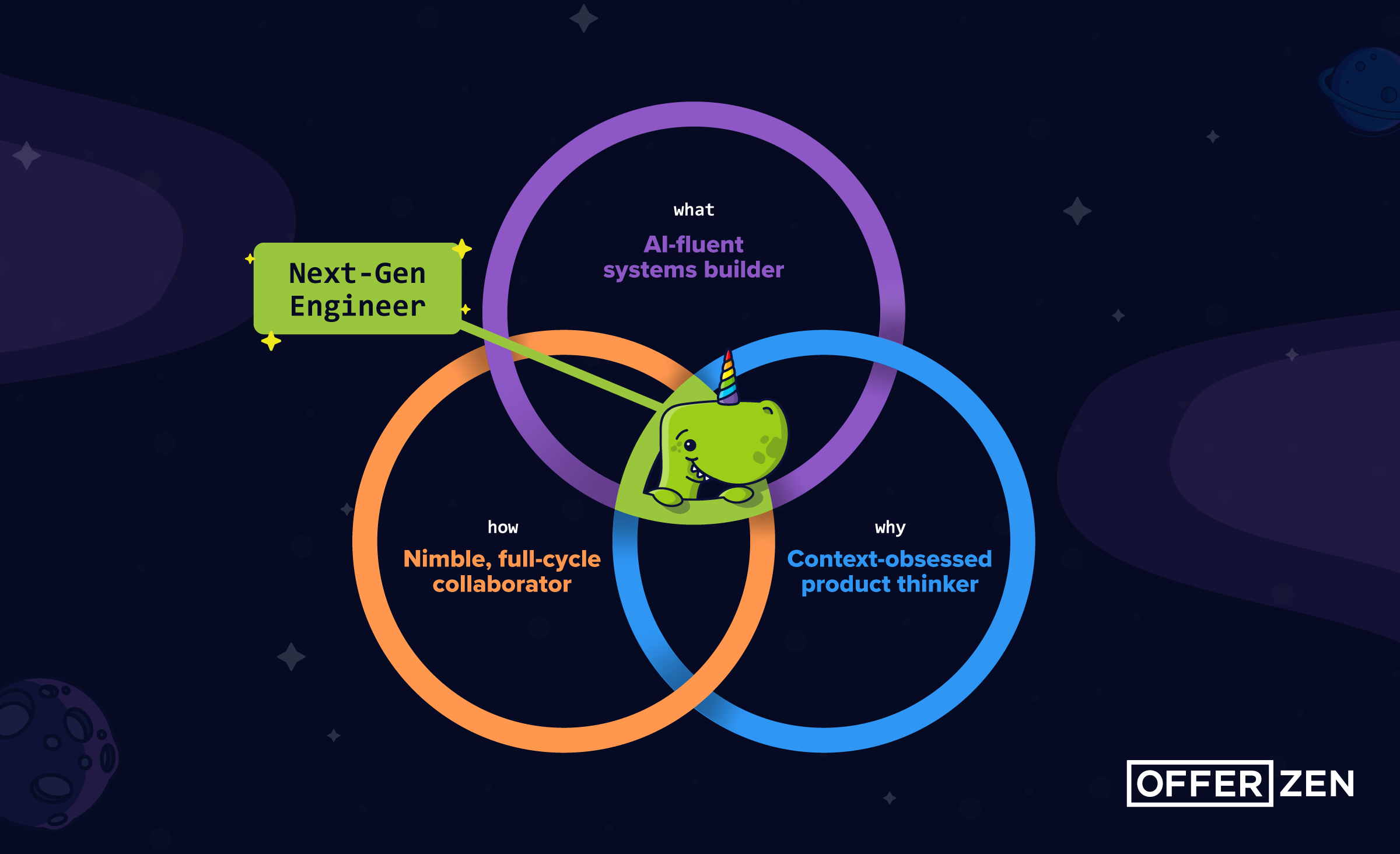
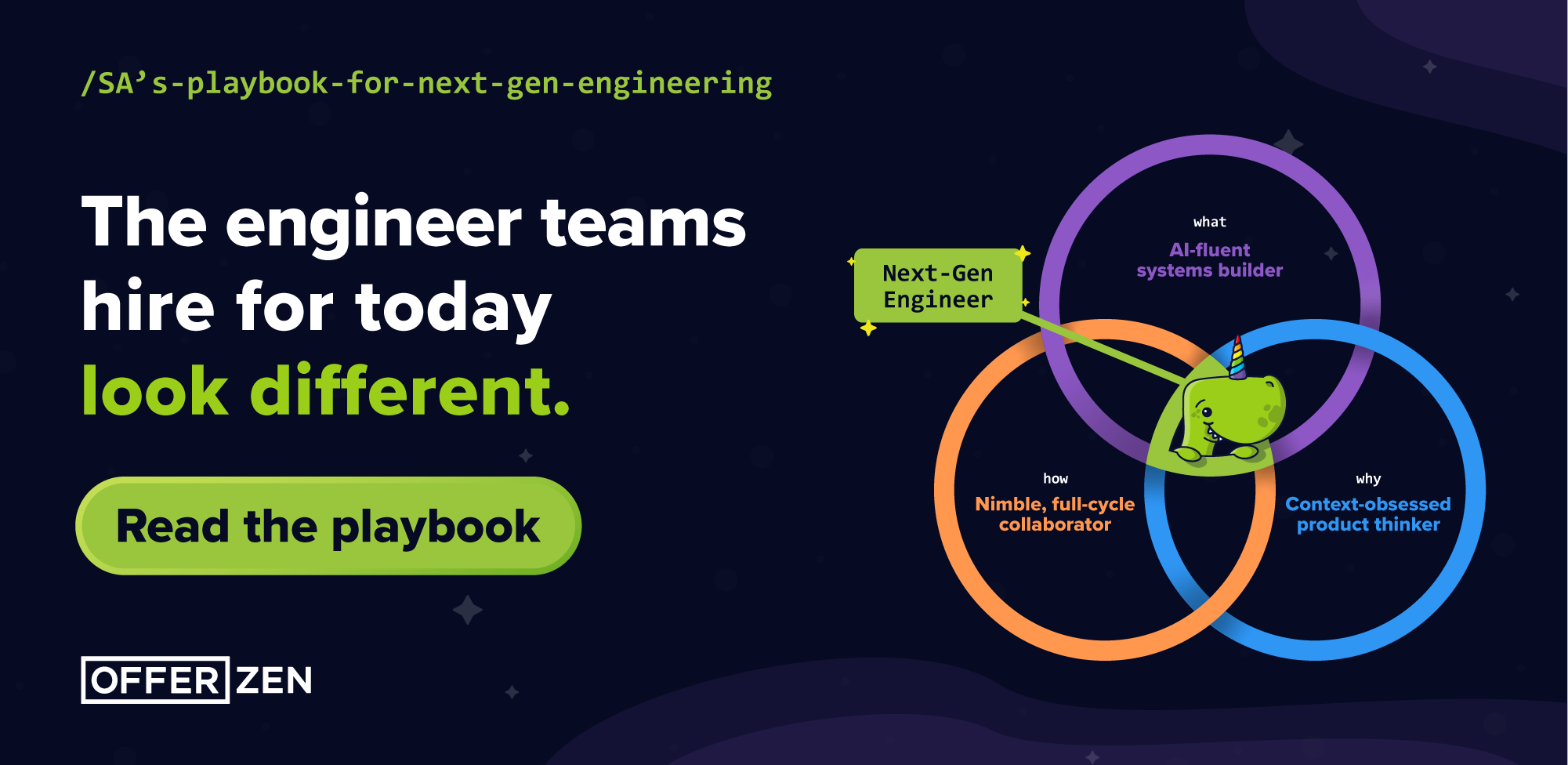
Together, the skills we’ve explored describe what it means to be a next-gen engineer.
A next-gen engineer is:
- An AI-fluent systems builder who uses AI to solve problems, make sound technical decisions, and design resilient systems.
- A nimble full-cycle collaborator who communicates effectively and works across disciplines to deliver outcomes.
- A context-obsessed product thinker who understands the business, the customer, and chooses the right problems to solve.
In practice
Next-gen engineering in action
Two engineers get the same brief: “Candidates are getting fewer matches. Fix it.”
The first engineer gets to work immediately. Two days later, the view numbers look better, but the match rate hasn’t changed. Candidates are getting more views, just not from the right companies.
The next-gen engineer starts by asking a different question: “Are we sure matching volume is actually the problem?” She brings the Customer Success team into a call, not to brief them, but to learn from them. Within an hour, she has her answer. Companies and candidates are describing the same skills in completely different ways. A candidate says “data analysis.” A company says “business intelligence.” The system treats them as different skills.
The next-gen engineer doesn’t solve the problem alone. She works with the Customer Success team to map the patterns, partners with Product to understand the business impact, and checks her assumptions with a few candidates.
Within two weeks, she ships a solution. She uses AI to prototype different approaches, generate test cases, and speed up implementation, giving her more time to validate the solution with customers and refine the experience.
Before calling it done, she goes back to the Customer Success team and asks, “Is this landing differently for your customers?” The question isn’t, “Did I build what was asked?” It’s, “Did we solve the right problem?”
The placement rate improves.
What about technical skills?
Technical skills are here to stay. Solid engineering fundamentals still count, and yes, sometimes you really do need to know a specific tool for a job.
But with AI in the mix, engineers can jump into new frameworks, pick up unfamiliar stacks faster, and ship production-ready code (as long as you set the right guardrails). That means the signals hiring managers look for are changing.
Instead of asking, “Have they used React?” engineering leaders are increasingly asking questions like:
- Can they design systems that scale?
- Can they frame the right problem before building?
- Can they evaluate AI-generated code critically?
- Can they navigate ambiguity and make good engineering decisions?
- Can they connect technical decisions to customer and business outcomes?
Those capabilities travel with an engineer, regardless of whether they’re working in Python today, React tomorrow, or a framework that hasn’t been invented yet.
The tools you know still matter. But more and more, they’re just proof you can learn and adapt–not the main event.
How can junior developers build these skills?
Most of these in-demand skills for developers become sharper with experience. Systems thinking, product judgement, and ownership are muscles you build by tackling real-world problems over time.
But that doesn’t mean that companies aren’t looking for juniors. Quite the opposite. Engineering leaders told us they’re excited about juniors who are curious, adaptable, and eager to experiment with new ways of building.
The good news is you don’t need a senior title to start building these habits. Here are five practical ways to get started.
1. Pair with engineers who are more experienced than you
Pair programming is hands-down one of the quickest ways to sharpen your judgement. When you watch experienced engineers tackle ambiguous problems, question assumptions, review AI-generated code, and weigh trade-offs, you pick up skills you just won’t get from tutorials.
But don’t just sit back and watch what they build. Ask them why they made certain decisions. That’s where the real learning happens.
2. Join hackathons and build with other people
Hackathons push you to build fast, team up with people you barely know, and communicate like your project depends on it–because it does. You’ll probably pick up more about collaboration, product thinking, and real ownership in one weekend than you ever would slogging through another solo tutorial.
Looking for somewhere to start? Explore upcoming hackathons, meetups, and tech events in your area on OfferZen Community Events.
3. Build something you’re genuinely curious about
Please, not another weather app.
Pick a problem you actually care about. Automate something that makes you groan, or build a tool for your favourite hobby. Let AI help you learn, speed up your prototyping, or push you into new territory you might have skipped. Just be ready to explain your decisions, the trade-offs you made, and where AI gave you a boost–or tripped you up.
Side projects are one of the clearest signals you can send to a hiring manager. They show curiosity, initiative, and how you actually think as an engineer. Years of experience are great, but side projects reveal what you build when nobody’s telling you what to do. That’s exactly what engineering leaders want to see.
4. Explain every technical decision
No matter if you’re working on a pull request, building a side project, or prepping for an interview, get in the habit of answering these questions:
- Why did I choose this?
- What alternatives did I consider?
- What trade-offs did I make?
This kind of thinking is exactly what companies are looking for more and more.
5. Learn the product, not just the code
Engineering leaders agree: developers today need to get the business and customer context, not just crank out code from a ticket. Do this:
- Join a customer demo and see firsthand how people actually use the product.
- Dig into support tickets to spot real-world pain points and questions.
- Ask your product manager why a feature matters, not just what it does.
The future belongs to next-gen engineers
OfferZen is the trusted home of tech leadership and thriving tech teams in South Africa – helping developers find forward-thinking companies, and helping engineering leaders build teams ready for the future.
Ready for what’s next? Find a dev job or hire AI-fluent developers.