Hiring great engineers has never been more complex.
On paper, companies have more tools than ever: sourcing platforms, assessments, AI screeners, interview frameworks. In reality, the experience often still looks the same. A LinkedIn message. A job spec. A test. A few interviews. Then… silence.
At the same time, the engineers you most want to hire are asking better questions:
- Will the work actually matter?
- Will I grow here, or just stay busy?
- Will this process be fair, transparent and respectful of my time?
- Will I be joining a team that takes both engineering and people seriously?
Traditional hiring is good at testing individual competence. What it struggles to show is how someone works with others, how they respond to uncertainty, or what it feels like to build inside your organisation.
That gap is exactly where this story starts.
In 2025, BET Software chose not to add another interview round or assessment tool. Instead, they ran a focused experiment: could they design a hiring experience engineers would genuinely want to be part of, and that would give their teams richer, more human signal in return?
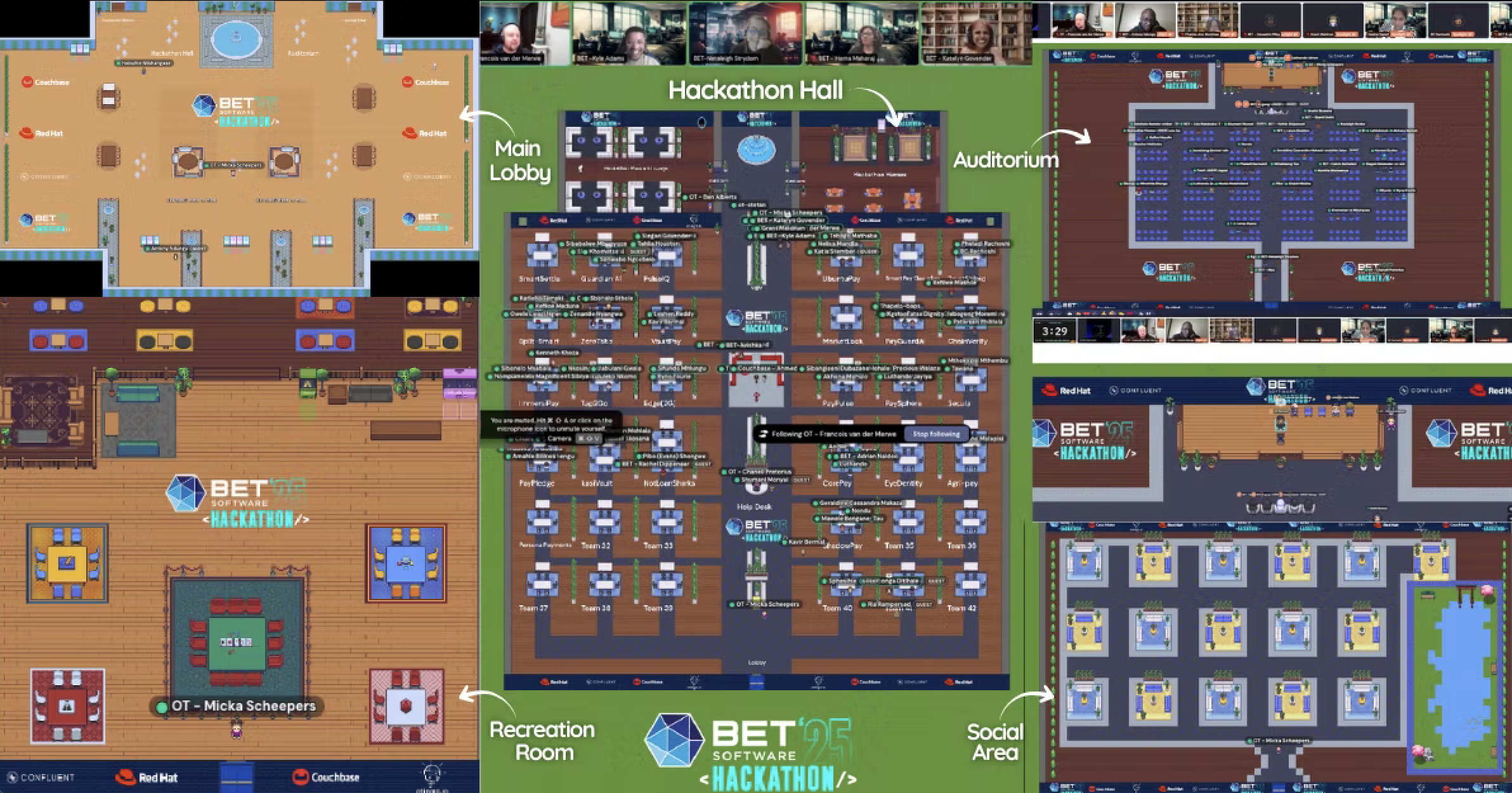
Together with Otinga and OfferZen, BET Software ran a fully virtual FinTech Innovation Hackathon: 36 hours of building, learning and collaborating on real payment challenges, observed in real time by mentors and hiring managers.
Why this matters now
Across leadership teams, the same questions keep coming up:
How do we stand out in an overcrowded talent market? How do we trust hiring decisions when CVs and coding tests all blur together? How do we give candidates an experience that actually reflects our culture?
The BET Software hackathon sits right at the intersection of these questions.
It shows what happens when:
- Hiring is treated as a designed experience, not a conveyor belt of requisitions.
- Technology is used to support people, not replace them.
- Behaviour, collaboration and follow‑through matter as much as raw technical skill.
At its core, this was a focused experiment with clear guardrails. Low risk. High learning. Deeply aligned to the kind of engineers BET Software wanted to hire. For engineers, it felt less like being filtered, and more like being invited into a meaningful, time‑boxed challenge.
What happened
Before we get into the how, it’s worth pausing on what actually happened.
- R50,000 in prizes
- 2,300+ applications from engineers willing to opt into a demanding, skills‑based process
- 600+ shortlisted through structured screening
- ~160 finalists invited to the live hackathon
- 130+ engineers who showed up for the full 36 hours
- 50+ teams formed around real fintech challenges
- 40+ demos delivered
- A completion rate above 90% (compared to ~60% in many public hackathons)
Seen through a hiring lens, each stage told a different story.
Interest at scale signalled strong brand pull. Shortlisting created focus. Showing up for a full weekend demonstrated intent. Finishing and demoing showed follow‑through, resilience and teamwork.
This wasn’t just a big event. It was a structured journey from curiosity to commitment.
The talent challenge BET Software was trying to solve
Like many growing tech companies, BET Software was competing for engineers who could work almost anywhere. They weren’t just looking for people who could pass a coding test. They needed engineers who could:
- Think in systems
- Work comfortably in complex payment environments
- Collaborate under pressure
- Take ownership when problems are only half‑defined
From the candidate side, engineers wanted more than salary bands and tech stacks. They wanted to understand whether the work would be meaningful and whether the company would respect their time.
A standard interview loop couldn’t answer those questions for either side. The hackathon emerged as a way to bring both sides into the same space and let real work do the talking.
Introducing: a virtual fintech talent hackathon
At its simplest, the format was clear:
- 36 hours, time‑boxed
- Real fintech and payments challenges
- Team‑based work, not individual tests
- A clear finish line: live demos
For BET Software, this mirrored reality far more closely than an assessment ever could. For participants, it felt like a compressed product sprint, not an exam.
Key design choices made it work:
- Fintech as the anchor theme
- Virtual by design, opening access across regions
- Space for behaviour to surface naturally
The infrastructure: structure without friction
Two layers held everything together.
Otinga’s AI‑powered platform handled applications, screening, communication, judging and the capture of both technical and behavioural signals. Everyone knew the rules, timelines and criteria.
Gather added the human layer. Instead of static video calls, participants moved through a shared virtual space. Mentors dropped in. Hiring managers observed. Conversations happened naturally.
The result: clarity without coldness, structure without stiffness.
A talent funnel with real signal
Each step in the funnel revealed something meaningful:
- Applying showed interest
- Shortlisting showed baseline fit
- Showing up showed intent
- Finishing showed ownership, persistence and teamwork
That 90%+ completion rate mattered. It quietly filtered for behaviours that are hard to fake and hard to surface in interviews: accountability, resilience and follow‑through.
Hiring conversations after the event were grounded in shared experience, not hypotheticals.
Human‑centred hiring and the ‘secret shopper’ lens
Throughout the weekend, hiring managers joined as participants, not judges.
They observed how teams worked, how people handled feedback, how they navigated tension and fatigue. Afterwards, those observations were captured as simple, structured signals: teamwork, growth mindset, coachability, leadership and critical thinking.
For candidates, this didn’t feel like surveillance. It felt like mentorship and genuine interest. For BET Software, it created a far richer picture of how people actually work.
The talent experience and employer brand effect
Ask participants what stood out, and a few themes come up again and again:
- Real learning and stretch
- Strong peer connection
- Mentorship that genuinely helped
- And, unexpectedly, fun
People shared their experiences publicly, not because they were asked to, but because they wanted to. Screenshots, reflections, team shout‑outs. Employer brand became a by‑product of a good experience, not a campaign.
Beyond hiring: the wider impact
- For organisations, this created a sharper pipeline and a repeatable model.
- For participants, it delivered skills, confidence and stories they could carry forward.
- For the ecosystem, it sent a signal: hiring can be transparent, human and grounded in real work.
What this points to next
The biggest lesson was simple: When you design hiring as an experience people move through together, everything changes. Technology does the heavy lifting. Humans do the human work.
A well‑designed hackathon won’t replace all hiring. But for the right roles, at the right moments, it can turn hiring from a series of hoops into a shared act of building.
And that’s where trust, learning and long‑term fit actually start.